
Top Signs You Need Garage Door Service – Don’t Ignore These
Most homeowners wait for a garage door to stop working entirely before they call anyone. That’s backwards. A door that hesitates for two seconds before it moves isn’t an annoyance – it’s a logic board or photo-eye signal that’s already degraded well past normal function, and it usually goes from slow to completely dead in under two weeks. The useful question isn’t “is my door broken?” It’s “how long do I actually have?”
Below, we rank the warning signs by urgency, not by how loud they are. Some give you months. Others give you days. If you’d rather have a technician look at it than climb a ladder yourself, call (833) 304-2178 for a free estimate.
Key Takeaways
- Tier 1 symptoms (uneven travel, frayed cables, a door that reverses on its own) mean stop using the door and get it looked at within about 48 hours.
- Tier 2 symptoms (grinding rollers, a dry-sounding spring, a slow opener) are safe to monitor but should be scheduled within 30 days.
- Tier 3 symptoms (minor vibration, a slightly loose hinge) can wait for your next tune-up.
- The shape of your floor gap tells you whether it’s a seal problem or a track-and-roller problem.
- Ignoring a Tier 1 issue can turn a modest repair into a full spring or opener replacement.
What Are the Tier 1 Warning Signs That Need Service Within 48 Hours?
Tier 1 signs are the ones where continued use of the door risks damage to the door, the opener, or anyone standing near it. In our experience across Canton, these are the calls that become emergencies if they aren’t handled. Stop operating the door and get it evaluated within roughly 48 hours when you see any of the following:
- The door reverses on its own or stops mid-travel. This is a safety-reversing failure, which is often a photo-eye or limit-switch fault. A door that reverses unpredictably is a door you shouldn’t trust around kids or pets.
- You can see individual broken wires in a cable. A frayed lift cable has lost a portion of its strength. It won’t heal, and it can fail under load.
- A visible gap or slack in the torsion spring. A spring that’s dropped, or that hangs with visible separation, is close to failing. That’s a stop-and-call situation.
- The door hangs crooked or one side lags. Uneven travel usually points to a stretched cable, a slipping drum, or a binding track, and it compounds fast.
We want to be blunt about springs and cables: these are the genuinely dangerous parts of a garage door. Torsion springs are under high tension, and a failed spring or snapped cable can cause serious injury. Don’t try to tighten, loosen, or remove them yourself. That’s a job for a trained technician, and we handle garage door spring repair as a core specialty here in Canton for exactly that reason.
Which Signs Give You a 30-Day Window (And Which Are Just Maintenance)?
Tier 2 symptoms are the ones that are irritating but not immediately dangerous. You can usually schedule these within 30 days without risk, as long as the door still opens and closes reliably. In Canton, the most common Tier 2 calls we handle fall into three buckets: worn rollers, a dry-sounding spring, and an opener that’s aging out.
Here’s a quick way to tell them apart by sound. This is the part most symptom lists skip entirely:
- Worn roller: a rhythmic squeal or rumble that speeds up and slows down in step with the door’s travel. The noise rises and falls with the door’s speed. Nine times out of ten it’s a nylon or steel roller that’s dry or flat-spotted.
- Dry torsion spring: a sharp chirp or creak at the start and finish of the cycle, not in the middle. Springs that need proper lubrication complain at the turnaround points.
- Loose track bolt: a clank or rattle that happens when the door hits a bump in the track, usually at a corner or a bracket. It’s more of a knock than a squeal.
Tier 3 symptoms – minor vibration, a hinge that’s slightly loose, a seal with a small gap – can wait for your next tune-up. None of them are unsafe on their own.
The 90-Second Cable Test You Can Do Yourself
You don’t need tools for this, and it takes a minute and a half. With the door fully closed and the springs at rest, stand to one side of the door and look up at the two cables running down the sides. Don’t reach in or touch them. Here’s what you’re actually looking for:
- Broken filaments: Fraying looks like a worn rope. You’ll see individual wires peeled away from the bundle, or a fuzzy edge where the cable wraps a drum.
- Kinks and birdcaging: A healthy cable is a smooth, straight line under tension. Kinks, curls, or a “birdcage” bulge near the drum mean the cable has been overstressed.
- Rust and nicks: Surface rust means the cable is losing strength. Deep nicks are failure points waiting to happen.
- Slack: A cable that visibly hangs loose rather than staying taut is a red flag, especially if the door is otherwise closed.
If you see any of these, call before you cycle the door again. A technician can confirm what’s going on in a few minutes. For anything beyond visual inspection, our garage door repair team can take a look and give you a straight answer.
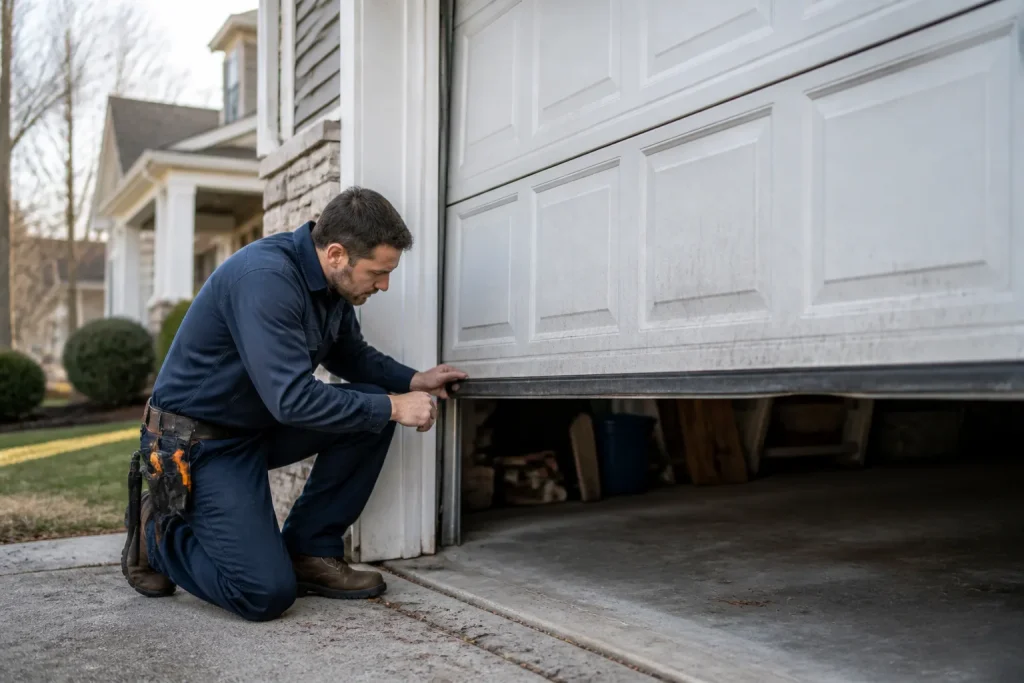
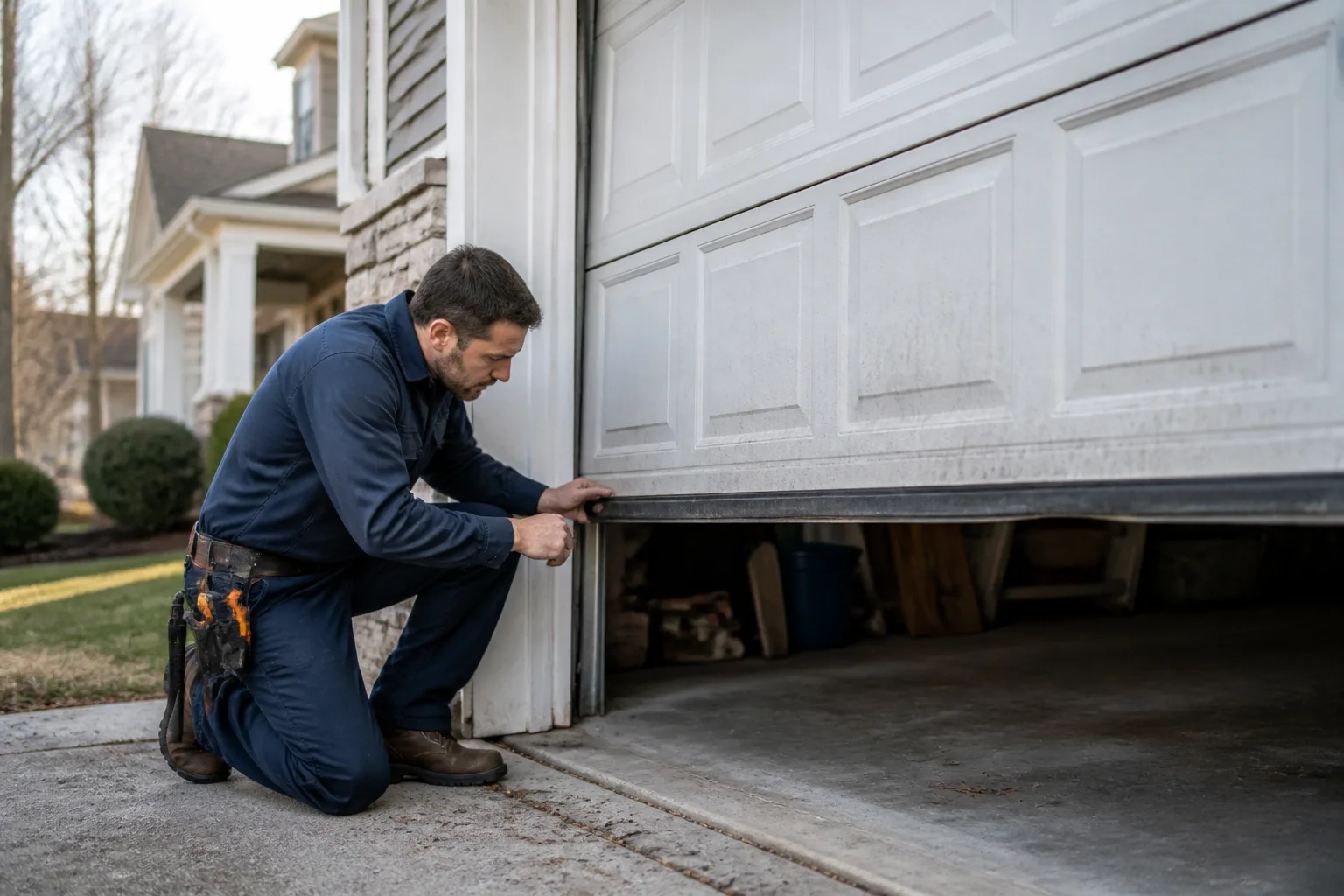
Why Does My Door Have a Gap at the Floor in Winter but Not Summer?
An uneven gap at the floor is one of those symptoms that changes with the season, and the reason is part alignment and part temperature. Here’s the simple test: look at the shape of the gap.
- A uniform gap across the whole door that gets worse in cold snaps: that’s usually a bottom seal issue. The rubber seal hardens and shrinks in the cold, so it no longer presses against the floor. In Canton, a hard cold snap can make an older seal look worse overnight.
- A wedge-shaped gap, wide at one side and narrow at the other: that’s a roller or track problem, not the seal. A worn roller, a bent track, or a misaligned drum is tilting the door rather than letting it sit flat.
- A gap that appears warm-weather only: track expansion and a loose roller usually account for that. It doesn’t mean the door is fine – it just tells you where to look.
If the shape of the gap changes with the season but the door still sits flat, start with the seal. If the gap is always on one side, it’s a mechanical issue. Either way, don’t ignore it: a persistent gap lets water, rodents, and cold air into your garage.
How Ignoring a Tier 1 Sign Turns a Small Repair Into a Big One
This is the failure chain that catches homeowners out. It usually goes like this:
- Day 1-3: A worn roller starts binding on one side of the track.
- Day 4-7: The binding drags the door unevenly, putting extra load on the torsion spring as the opener strains to compensate.
- Day 8-14: The spring, already near end of life, loses tension and fails. Now the door is stuck, or worse, hanging with a slack spring.
- What started as a roller replacement becomes a spring replacement plus a door that needs to be properly balanced – and if the opener got strained along the way, that’s next.
A single repair can grow into a much larger job once the failure chain gets going. That’s the real reason we push Tier 1 issues hard: the savings come from catching them early, not from waiting to see if they sort themselves out. And if the opener is what’s failing, we work on LiftMaster, Chamberlain, Genie, Craftsman, Raynor, Wayne Dalton, Clopay, and Amarr – so we know your system before we touch it.
When Should You Call a Pro Instead of Checking It Yourself?
Call a pro for anything involving springs, cables, or the opener’s electrical side. Those are the components that hurt people when something goes wrong. A trained technician can also tell you over the phone, from the sound description alone, whether it’s a roller or a spring – which saves you time and a second visit. If you’re in Canton and can’t see the problem clearly, describe the sound. It’s often enough. We answer 24/7, with fast dispatch from 7am to 7pm, Sunday through Friday.
For a door that’s past repair, we also handle full installation, so you aren’t stuck finding an installer after a repair technician gives you the bad news. Our technicians have up to 10 years of experience, and we do the work on-site for repair, opener service, springs, and new doors.
The Bottom Line
Tier 1 signs – uneven travel, a frayed cable, a door that reverses, a spring with visible slack – mean stop using the door and get it looked at within 48 hours. Tier 2 signs like grinding rollers, a dry-sounding spring, or a slow opener should go on your calendar within a month. Tier 3 signs can wait for your next tune-up. The earlier you catch a symptom, the cheaper it stays.
If you’re in Canton and need help, Canton Garage Door Repair Experts offers free estimates – call (833) 304-2178. The price is quoted and agreed before any work starts, so you know what you’re getting into before we do anything. And if your opener is the culprit, our garage door opener repair team works on your brand.
Related services in Canton: if a spring failure has already happened, don’t cycle the door again – get it checked the same day. Our team is also your source for Canton Garage Door Repair Experts across the full service lineup.
Frequently Asked Questions
If the door reverses on its own, hangs crooked, or you can see broken wires or slack in a spring, stop using it and call within about 48 hours. Any other symptom – grinding, squealing, a slow opener – can usually wait a few weeks. Call (833) 304-2178 for a free estimate; we’ll help you sort a Tier 1 from a Tier 3.
It usually means a worn roller or a dry hinge, especially if the sound rises and falls with the door’s speed. A sharp chirp at the top or bottom of travel is more likely a dry spring, and a clank is usually a loose track bolt. A technician can confirm from a description or a quick look.
No. Torsion springs are under high tension, and a failed spring or snapped cable can cause serious injury. Don’t try to tighten or remove one yourself. Call a trained technician – spring repair is our specialty, and we do it safely.
It depends on the tier. Tier 1 issues are unsafe after about 48 hours. Tier 2 issues should be scheduled within 30 days. Tier 3 issues can wait for your next tune-up. The problem with waiting on Tier 1 signs is that a small repair can turn into a string of them.
Written by the team at Canton Garage Door Repair Experts.
Need Garage Door Help?
Call Canton Garage Door Repair Experts - the local pro we connect you with is licensed and insured, here with fast help in Canton.
(833) 304-2178